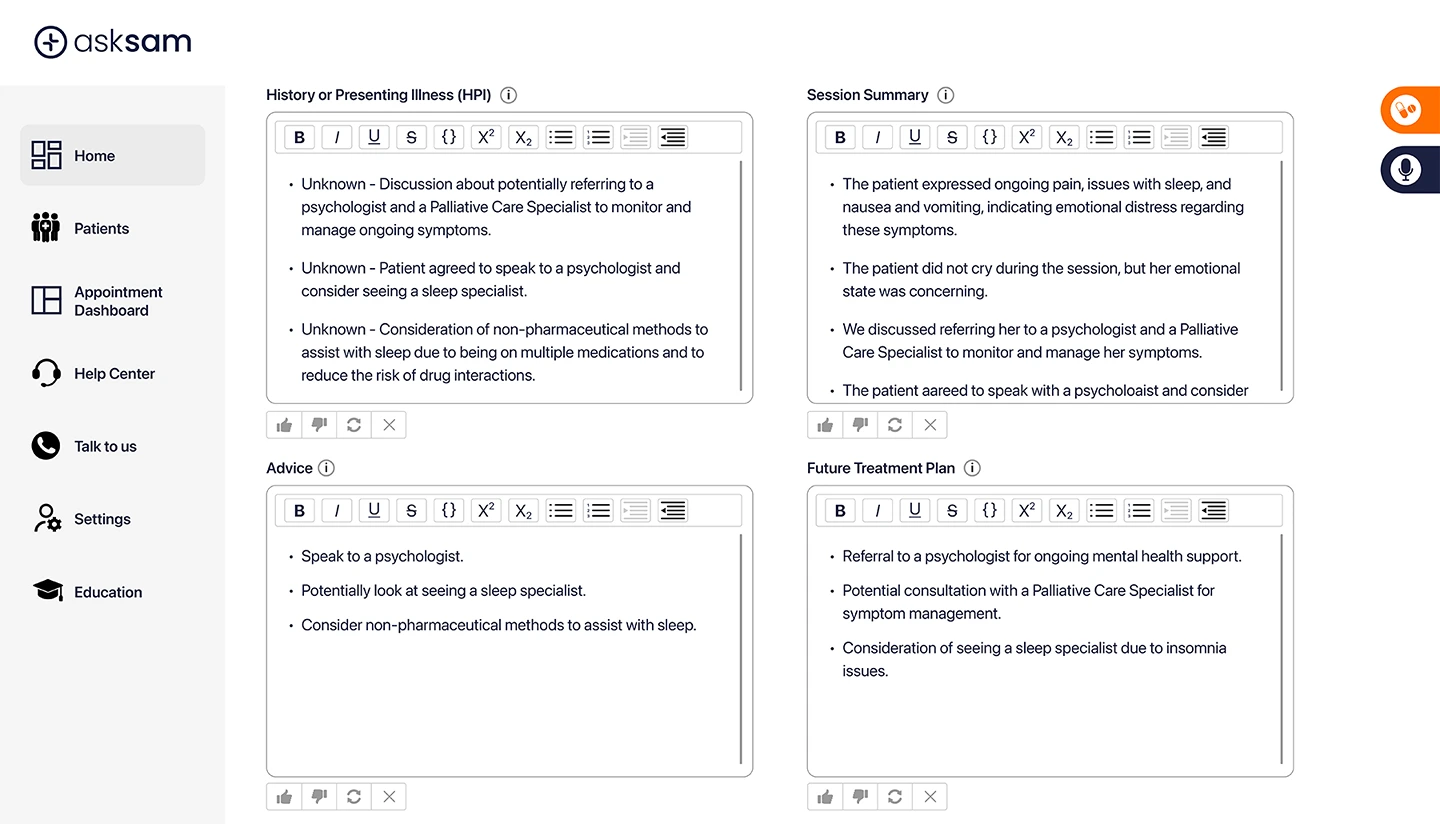


This library of papers showcase peer-reviewed studies and scholarly articles that form the scientific backbone of our work. These publications detail rigorous experiments, analyses, and findings — providing transparency, context, and credibility. They allow experts, clinicians, and researchers to dive deep into the evidence behind our innovations, examine methodology, and build on our findings.
- Research Papers
LLMs Will Always Hallucinate, and We Need to Live With This
1 February, 2024
- Research Papers
The Vulnerability of Language Model Benchmarks: Do They Accurately Reflect True LLM Performance?
2 December, 2024
- Research Papers
High-precision medical speech recognition through synthetic data and semantic correction: UNITED-MEDASR
24 November, 2024
- Research Papers
First Train to Generate, then Generate to Train: UnitedSynT5 for Few-Shot NLI
12 December, 2024
- Research Papers
Securing Well-Being: Exploring Security Protocols and Mitigating Risks in AI-Driven Mental Health Chatbots for Employees
1 January, 2024
- Research Papers
Chatbot-Enhanced Mental Health First Aid in Corporate Settings: Addressing Risks, Implementing Crisis Management, and Promoting Employee Well-Being
10 November, 2024
- Research Papers
Boosting Workplace Well-Being: A Novel Approach with a Mental Health Chatbot for Employee Engagement and Satisfaction
12 January, 2024
Our registered Patents highlight the unique inventions and technical solutions we’ve developed — from algorithms to processes — and for which we’ve secured formal intellectual-property protection. By listing our patents, we emphasise our commitment to original thinking and innovation.
- Patent
Translation with Clinical Precision
- Patent
Text to emotion vector generation
- Patent
LLM Hallucination Mitigation
- Patent
Fake information classification
- Patent
Clinician like Discharge Summary generation
- Patent
Causality driven Graph Neural Network for Mental Health Prognosis
- Patent
Stochastic Actor Oriented Model driven Clinician Suggestion
- Patent
Clinical Case History Generation
- Patent
Deltawave guided wearable EEG happiness Monitors
- Patent
Interoperable EHR Taxonomy and Data Mapper
- Patent
Stella for Clinician
- Patent
Phoneme Viseme
If you want to know more about our intellectual properties, you can reach out to us.
Our World Records section celebrates standout achievements where we have reached — or surpassed — performance benchmarks on global leaderboards. These records reflect exceptional performance, often setting new standards in accuracy, efficiency or innovation.
| Benchmark | Type | Score (asksam™) | Prev. Record | Prev. Holder | Leaderboard |
|---|---|---|---|---|---|
| SNLI | NLI | 94.2% | 93.1% | EFL by Meta | View SOTA |
| eSNLI | NLI | 94.01% | 81.71% | Oxford, UCL, Deepmind | View SOTA |
| MultiNLI | NLI | 92.6% | 91.8% | OpenAI | View SOTA |
| LibreSpeech | ASR | 0.986 (WER) | 1.34 | View SOTA | |
| Europarl | ASR | 0.432 (WER) | 7 | MMPL | View SOTA |
| Tedlium | ASR | 0.293 (WER) | 3.92 | NVIDIA | View SOTA |
| FLEURS (English) | ASR | 0.336 (WER) | 21.9 | Meta (Multilingual) | View SOTA |